
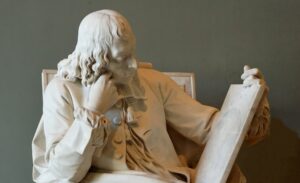
By John F. Doherty, Public Discourse. (Image: Blaise Pascal, Louvre, Public Domain)
If reports are correct, religion is regaining ground among young people in America and elsewhere. But in absolute terms, the number of religiously observant Westerners remains historically low, while the number of religious “nones”—atheists, agnostics, and the indifferent—is higher than ever. What could believers do to help turn the recent uptick in theism into a larger religious revival?
Spreading traditional rational arguments for God’s existence, like Thomas Aquinas’s five proofs, may not be very helpful. Those arguments presume their hearers agree that unchanging, transcendent truths exist, and that it is better to live by them than not. But many today lack such convictions. Critical Marxists believe that transcendent truth is irrelevant to people’s real needs. For them, “the reality or non-reality of thinking” is determined only by what works in “practice.” Those who reason according to transcendent principles and logic, they say, only seek to force their preferences on others; all rational argument is rationalization. Truths are at best the findings of empirical science, which are continually being revised; truth is not a timeless reality existing above us. Technocrats who accept such materialism, but not Marxism’s disruptive, revolutionary spirit, seek to subordinate religion, and all truth-seeking idealism, to material “well-being.”
Then there are the countless masses who experience life as if God did not exist, even if they think of themselves as religious. They find life “disenchanted,” thin on meaning, each day feeling like just “one d— thing after another.” For many, life seems like a game directed by forces beyond our control, be they “evolution,” “the market,” “the deep state,” or social media algorithms. Our lives are organized by technology that most of us don’t understand; we trust technology, and “the experts” who make it, simply because it works. And yet the experts don’t always understand what they make, as with so-called “artificial intelligence.”
Appeals to absolute truth, moral or otherwise, are unlikely to persuade people formed in the practical, experimental logic of our time. A better defense of theism might rather take the approach of the seventeenth-century French mathematician and philosopher Blaise Pascal.