
The abrupt cancelling of an award to a senior Muslim cleric by the Archbishop of Canterbury will damage to Christian-Muslim relations in Pakistan, according to the head of the Church in Pakistan.
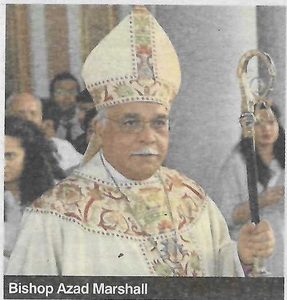
Bishop Azad Marshall has called fo’r Archbishop Mullally to apologise to the imam, Tahir Ashrafi, for the way he has been treated.
Contrary to what the British media have reported, Bishop Marshall says that Ashrafi has been a friend and protector of the Christian community in Pakistan, shielding them from lynch mobs and false blasphemy charges.
The Hubert Walter Award for Recon-ciliation and Interfaith Cooperation was given to Hafiz Muhammad Tahir Me-hmood Ashrafi, a senior Islamic cleric who leads the All Pakistan Ulema Coun-cil. He also chairs the Peace Committee, a government initiative for peace and harmony in fragile and often volatile Pa-kistan. Known lo millions of Pakistani Muslims, his attitude towards Christians carries considerable weight.
Ashrafi had previously attracted con-troversy for remarks concerning Osa-ma bin Laden. In 2007, he said that bin Laden “must be given the lofty title of Is-lam: Saifullah”. meaning ‘Sword of God’. However, he has claimed that this was a sarcastic response to the knighthood be-stowed on Sir Salman Rushdie at a time when feelings were running high ir,i Pa-kistan over the author’s apparent blasphemy.
These nuances were not apparent to the media nor known to Lambeth Palace when the Archbishop presented the award on 11 September, the 25th anni-versary of the 9/11 attacks on the World Trade Centre – which, as Bishop Marshall highlighted, showed a “serious lack of due diligence”.
As a media storm erupted, Lambeth Palace hastily withdrew the award.
Now the Anglican Church in Pakistan blames the Church of England for ”betraying a long and strenuous effort to build interfaith ties”, according to Bishop Marshall. who also highlights how powerfully Pakistani shame cultu will affect the work “We’ve been deeply humiliated. It’s very embarrassing for [the imam] and his family. He trusted Canterbury as a Church office.”
Bishop Marshall also claims that this “highest offence” against ‘the Maulana’ (the term of a respected Islamic scholar) has caused the Church to lose standing within Pakistan.
Bishop Marshall insists that Ashrafi’s defence of Christians shows his inter-faith tolerance, and he is not responsible for Pakistan’s notorious blasphemy laws, which have seen Christians such as Asia Bibi imprisoned on trumped-up charges. “In fact, Tahir Ashrafi has actively de-fended those who are vulnerable under these laws. I went to him myself with such concerns, and he never once gave the impression that he was unconcerned. In the case of Rimsha Masih, a young girl with learning disabilities, who was accused of blasphemy, Ashrafi and another Christian politician worked closely to-gether for her release and safety.
“In the case of Jaranwala, Christian town that was burnt and set aflame, the – Maulana spoke up and condemned the action. He worked with the Church to de-mand action and reparation.”
Bishop Marshall adds: “We are praying for this situation. In grace and hope, we wait for Lambeth to set this right and rec-ognise the crisis unleashed among our faith communities and our leaders.”
For the Church in Pakistan, Bishop Marshall believes the apology will prove whether the Church in the UK “genuinely cares” about the damage done to their community.
Heart newspaper. www.heartpublications.co.uk October/November 2026 p.16