
By Gabriel Neville, Juicy Ecumenism.
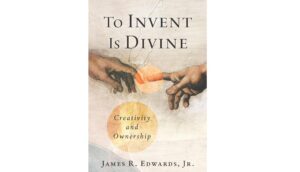
Book Review: To Invent is Divine: Creativity and Ownership, by James R. Edwards, Jr. Fidelis Pub, 2025. 344 pages.
“Thank God for modern medicine!” We hear this exclamation often, from believers and nonbelievers alike. That is apt, according to James Edwards, because creativity, property rights, and the technological advances that follow are part of God’s common grace.
Inventions of all kinds have made life better in ways we often take for granted. In 1867, Margaret Knight invented what today seems like one of the simplest items: a flat-bottomed paper sack. 159 years later, we still stuff our groceries with them when we choose paper over plastic. Decades before her gender could vote, the law protected her when infringers proved the design’s value by trying to steal it. Sadly, Mr. Edwards tells us in To Invent is Divine, the infringers now have the upper hand.
Faith & Law, the Capitol Hill ministry, has long argued that God cares about every area of public life. It may be hard, its members joke, to discern His views on transportation policy, but we know He has them. Mr. Edwards has found it easier to see what God’s will is when it comes to creativity and property. He makes a four-part case: 1) God is the supreme Creator; 2) God lays claim to all he has made; 3) humans, created in His image, are likewise creative and due the value of our works; and 4) the Creation Mandate requires us to use our faculties and the resources He has provided to advance human flourishing.
While all of this has been true since Eden, America was the first to align these principles with a system of law and government. The result has been remarkable. Few remember that Britain’s colonies were legally barred from manufacturing by the Navigation Acts (1660, 1663, and 1673). Colonial policy was extractive: colonists shipped timber, sugar, metals, indigo, and other raw materials exclusively to Britain, where they were turned into valuable goods and sold back to Americans. When Independence came, colonists had a strong, pent-up desire to make things and reap the full value of their labor and industry.
Americans saw property rights as God-given and fundamental.