
By George Conger, Anglican Ink.
The Anglican Centre in Rome has put GAFCON’s Abuja declaration on the table.
On 11 June 2026 the Centre will host a seminar entitled “‘The Future Has Arrived’: A Decolonial Reading of the Global Anglican Future Conference’s G26 Abuja Affirmation,” with Dr Ishaya Anthony giving the principal paper and Dr Christopher Wells, the Anglican Communion’s Director of Unity, Faith and Order, responding. The event will be held at the Centre’s rooms in the Palazzo Doria Pamphilj in Rome and online at 6:00 pm Central European Time (
That the subject is being taken up in Rome is worth noting. The Anglican Centre is not GAFCON territory. It is an ecumenical and Communion-facing institution, one accustomed to the patient language of dialogue and process. GAFCON’s Abuja Affirmation, by contrast, was not written in committee-room prose. It was written as a line in the sand.
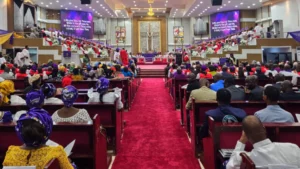
Meeting in Abuja from 3 to 6 March, GAFCON reported that 347 bishops and 121 clergy and lay leaders from 27 provinces had gathered under the hospitality of the Church of Nigeria. The resulting Abuja Affirmation declared that “The Future has Arrived,” rejected the Archbishop of Canterbury, Lambeth Conference, Anglican Consultative Council, and Primates’ Meeting as failed “so-called Instruments of Communion,” and announced the inauguration of a reordered Global Anglican Communion.
Abuja did not ask Canterbury to try harder. It did not plead for another listening process, another Windsor-style report, or another indaba with better refreshments. It declared the old system had failed because it could no longer discipline false teaching, especially over Scripture, sexuality, and the formularies of the Anglican Reformation.
Nor was Abuja merely a protest against the Church of England. GAFCON’s statement argued that communion is confessional before it is institutional, and that fellowship now rests on assent to the Jerusalem Declaration rather than historic deference to Canterbury. “There are not two Communions,” the statement said, “but two incompatible definitions of communion,” one confessional and one institutional.
That sentence turns the usual question upside down. The issue is no longer whether GAFCON has left the Anglican Communion. GAFCON’s claim is that the Canterbury system has ceased to be a reliable guardian of Anglican communion, and that the real Communion is being recovered elsewhere.
The Rome seminar appears designed to probe that claim rather than simply denounce it. Dr Anthony, Canon Theologian of the Diocese of Kwoi in Nigeria and a post-doctoral research fellow at the University of Johannesburg, will examine the Abuja text through a decolonial lens. That framing matters, because GAFCON has long rejected the charge that it is a Western conservative franchise dressed up in African vestments. Its leaders contend that the moral and theological center of Anglicanism has shifted southward, and that Canterbury has been too slow, too compromised, or too polite to notice.