
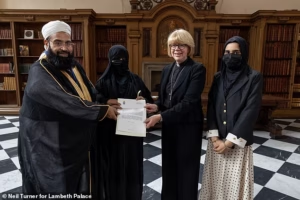
by George Conger, Anglican Ink
The story of the Hubert Walter Award is being discussed as though it were primarily a public-relations crisis — a miscommunication, a gap in the briefing process, an embarrassing week that will pass, a gaffe. It is none of those things. It is a window into something more serious: the chronic failure of the Church of England’s institutional leadership to apply to interfaith engagement the same rigor it demands, rightly, of every other area of public life.
No hospital awards a contract without checking a supplier’s record. No safeguarding officer approves a volunteer without a background check. No government minister presents a national honour without their department having run the recipient through every relevant database. These are not bureaucratic niceties. They are the minimum that serious institutions owe to the people they serve and the values they profess to hold.
Lambeth Palace is not short of staff, lawyers, communications advisers, or access to open-source information. A ten-minute search of Reuters and AFP archives would have surfaced Ashrafi’s 2007 statements in full. The question is therefore not whether the information was available. It is whether anyone looked — and, if they looked, whether anyone was willing to act on what they found.
That question cuts to something the Church of England has been reluctant to confront directly. Interfaith dialogue, as currently practised in many official Church contexts, has become less a theological discipline than a social performance — a demonstration of openness in which the act of engagement is treated as its own justification, and in which raising hard questions about a dialogue partner’s record is felt to be impolite, culturally presumptuous, or somehow inimical to the spirit of reconciliation. The result is an institution that confuses hospitality with credulity, and mistakes the appearance of bridge-building for the thing itself.