
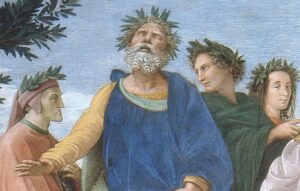
By Ioannis E. Kotoulas, European Conservative. (Image: Public Domain)
Homer’s epics are foundational to Western civilization. Their reinterpretation should enrich our understanding of the classical tradition, not distort its historical and cultural legacy.
In an age of ideologically driven distortion, defending our classical tradition is inseparable from defending our future. Homer’s Odyssey is the foundational epic of Western literature, an absolute literary masterpiece of immense richness, intellectual depth, and aesthetic beauty whose influence and importance echo through the centuries. German polymath Goethe described Homer’s epics, The Iliad and The Odyssey, as the two most important books in the world, since they have shaped the Western cultural psyche.
The Western canon of literature begins with these two foundational epics of ancient Greece by poet Homer (8th century BC). The Iliad recounts the siege and fall of Troy by the alliance of Mycenaean Greeks featuring such emblematic figures as Achilles, Odysseus, Agamemnon, and Hector. The Odyssey describes the return of its hero, Odysseus, to his homeland after many adventures on the seas and among different civilizations. Homer’s Odyssey is a major work of art that has established the poetic prototype for the hero wandering the world and facing dangers in his quest to return home to his family and fatherland. The Odyssey is a story about the love of fatherland and the power of νόστος—nostos, the return home. The term ‘nostalgia’—from the beautiful Greek word νοσταλγία, ‘pain over the wish to return home’—derives from ‘nostos.’ Returning from Troy, Odysseus “saw the cities of many men and learned their mind,” in the words of the ancient poet. Odysseus wanders the ancient world, navigating between unknown societies, modes of political order, and cultural customs. His journey ends with his return to the familiar landscape of his fatherland and the cultural milieu of his nation. The Odyssey thus becomes a hymn to one’s beloved fatherland and family. Similarly, in the other Homeric epic, The Iliad, Hector, defending his native city Troy, is faced with foreboding omens of defeat by a soothsayer. His reply still echoes through the centuries as a testament to moral responsibility and political duty: “There is only one good omen/to fight for your fatherland.”