

from Western Spirit
For the first six centuries after Christ, Egypt was 100% Christian.
Today, Egypt is overwhelmingly Muslim, while the descendants of that ancient Christian civilization – the Copts – form a tiny minority.
So how did one of the great centers of early Christianity become a predominantly Muslim nation?…
The Arab Conquest
It all started in the year 639. Only a few years after the death of “Prophet” Muhammad, Arab Muslim armies under the command of Amr ibn al-As crossed the desert from Palestine and entered Byzantine Egypt. The campaign lasted nearly three years. The fortress of Babylon near modern Cairo fell after a long siege, and Alexandria, the great Mediterranean capital, surrendered by treaty in 642.
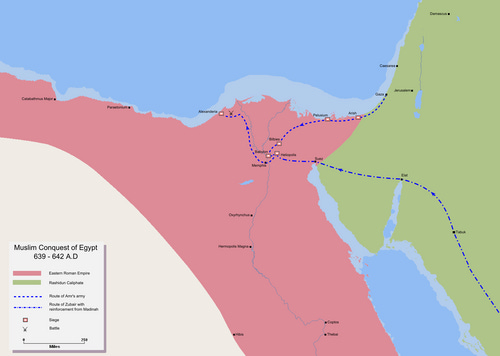
The overwhelming majority of Egyptians, however, remained Christian for generations afterward. Arabic historians such as al-Baladhuri record that treaties were concluded with many communities, permitting them to keep their churches and continue their worship in exchange for accepting Muslim authority and paying the jizya, the special tax required of non-Muslim subjects. Outwardly, Egypt still “looked” like a Christian country.
But the political foundation shifted completely. The Byzantine administration that had ruled for centuries was gone, and a new order based on Shariah law now held the land.
Life as a Dhimmi
With the new rulers came the dhimmi system, the legal framework that defined the place of Christians and Jews under Islamic governance. They were permitted to practice their religion, but only under conditions that marked them as subordinate. Every adult Christian man was required to pay the jizya. As it says in the Quran:
“Fight those who do not believe in Allah or in the Last Day and who do not consider unlawful what Allah and His Messenger have made unlawful and who do not adopt the religion of truth from those who were given the Scripture—[fight] until they give the jizyah willingly while they are humbled.”
Beyond the tax itself, Christian communities lived under a varying set of restrictions. Some governors ruled with relative pragmatism and left church affairs largely alone. Others enforced the regulations more strictly. Medieval chronicles, both Christian and Muslim, describe periods when churches were closed or demolished, public crosses were forbidden, Christians were barred from certain offices, and distinctive clothing was required so that non-Muslims could be instantly recognized. The experience changed from one dynasty to the next – Umayyad, Abbasid, Fatimid, Ayyubid, Mamluk – but the underlying legal distinction between Muslim and dhimmi never disappeared.