
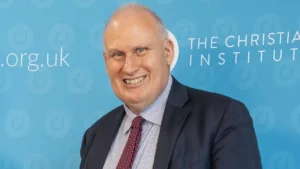
By Anon, Anglican Mainstream. (Photo: The Christian Institute)
Richard Turnbull, former Principal of Wycliffe Hall, Oxford, died on 26 November, having been diagnosed with terminal cancer.
Richard was born in South Manchester in 1960 and studied economics and accounting at Reading University. In his final year at Reading, he came to faith in Christ. He first embarked on a career as a Chartered Accountant with Ernst and Young. Then, on selection for theological training, he entered Cranmer Hall, Durham, where he gained a BA in 1992; he was ordained in 1994. Richard was awarded a PhD from Durham in 1997.
Following a curacy at Christ Church, Portswood (1994-1998) he served for seven years as vicar at Christ Church, Chineham, near Basingstoke, (1998-2005) before being appointed Principal of Wycliffe Hall in August 2005, succeeding Alister McGrath. That year, he received an honorary MA from the University of Oxford.
Richard Turnbull brought an unusual combination of skills and experience. He played an active role on the Church of England General Synod from 1995, as Chairman of the Business Committee (2004-2005) and as chair of working parties on clergy pay and the funding of theological education. He was for two years a member of the Archbishop’s Council (2003-2005) under Rowan Williams.
At Wycliffe Hall, he taught courses on Anglicanism, on Anglican and Evangelical identity, and on the Reformation. His early years at the Hall drew controversy over his management style, which was less collegial than some would have wanted; and over his unswervingly-conservative theology. Several faculty resignations followed. Concern was expressed that the appointing of conservative faculty to fill the vacancies would lead to applications from more conservative students, and to less intellectual rigour. On the contrary, Richard Turnbull had a high regard for scholarship, as was evidenced in his faculty appointments. He was a popular Principal, who showed a genuine care for his students, and was affectionately nicknamed Turbo.
Degree exams were just beginning when he was constrained to stand down from Wycliffe Hall in 2012. The student body was both shocked and saddened by his leaving. The exam results that summer placed Wycliffe top of the Permanent Private Halls by a clear margin, with a higher proportion of firsts than several of the better-known colleges. Any fear of his leadership bringing a lack of intellectual rigour to the Hall was to prove completely groundless.
In 2012 he founded the Centre for Enterprise, Markets and Ethics (CEME), with Brian Griffiths, Baron Griffiths of Fforestfach, former Advisor to Margaret Thatcher, as his board chair. Through conferences and publications, CEME would bring moral and theological reflection to matters of business and financial policy; and help Christians to see the business and financial worlds as a calling.
In 2017, Turnbull became a Trustee of the Christian Institute, taking over the chair in 2021. Ciarán Kelly, Director of the Christian Institute, said: ‘Richard was a phenomenal support to me after the sudden death of our founding director, Colin [Hart], 18 months ago. I appreciated his deep wisdom, borne out of his business as well as his ministry experience.’ He added: ‘Institute staff were also regular beneficiaries of his wisdom and knowledge. He provided training for staff, as well as frequently giving talks to the public at the Institute’s annual lecture series.’
James Leggett, a member of the Trust said, ‘His great gift was to combine quick thinking with thoughtfulness. As Chairman of The Christian Institute, he had the ability to lead graciously, listen intently, and then summarise succinctly for the good of the charity.’
Richard’s ministry had been much inspired by William Grimshaw of Haworth (1708-1763) and Grimshaw’s sheer perseverance. While not so well-known as the Wesleys, Wilberforce, John Newton and others, Grimshaw was counted among their friends and advisors, and himself played a significant part in the eighteenth century revival. Richard’s book ‘Reviving the heart: The story of the 18th century revival’ (2012) was published just as he stepped down from Wycliffe Hall. He was a keen historian, and had a gift for bringing a scholarly mind to his writing, while enabling it to be accessible to a broader audience. His published legacy includes a biographical appraisal of Lord Shaftesbury (2010), warmly commended by William Hague; and ‘Anglican and Evangelical?’ (2007) written from his well-informed perspective of the General Synod’s slow shift from orthodoxy, its finances, and its training colleges.
Richard is survived by his wife, Caroline, his four adult children, and his father.
© Anglican Mainstream