
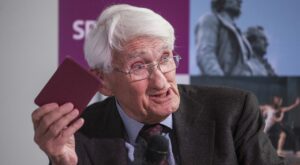
By John Sandeman, Anglican Ink. (Photo: Wikimedia Creative Commons)
The influential German philosopher Jürgen Habermas has died aged 96, leaving behind a body of work famous for a theory of political consensus-building. Despite being a member of the post-Marxist Frankfurt school that founded critical theory, he believed that Jewish and Christian thinking had formed the foundation of “moral universalism” that lies behind democratic egalitarian societies.
“In spite of his background in the neo-Marxist Frankfurt school and his reputation as a court philosopher of the Social Democratic party, his influence cut across party lines,” The Guardian reports. “German chancellor, Friedrich Merz, of the conservative Christian Democratic Union, described him as “one of the most significant thinkers of our time”.
“His analytical acuity shaped democratic discourse far beyond our country’s borders and served as a beacon in a stormy sea,” Merz said in a statement. “His voice will be missed”.
In a 1999 interview, “A Conversation About God and the World” published in his book “Time of Transitions” (Polity Press, 2006), he makes a bold claim.
“Egalitarian universalism, from which sprang the ideas of freedom and social solidarity, of an autonomous conduct of life and emancipation, of the individual morality of conscience, human rights and democracy, is the direct heir of the Judaic ethic of justice and the Christian ethic of love. This legacy, substantially unchanged, has been the object of continual critical appropriation and reinterpretation. To this day, there is no alternative to it. And in light of the current challenges of a postnational constellation, we continue to draw on the substance of this heritage. Everything else is just idle postmodern talk.”
Sometimes that quote is over-simplified to a claim that Christianity and nothing else directly led to democracy and Western civilisation, which, from a point of view that believes in a supernatural God guiding history, may be true, but Habermas was not as specific. Yet, given his eminence as a leader of the second wave of critical theorists, his statement still reads very boldly.