
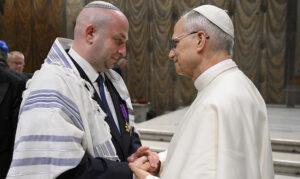
By Simone Rizkallah, Juicy Ecumenism. (Photo: CNS/Vatican Media)
The Catholic Church is a communion of 24 sui iuris churches, all in full communion with the Pope: Armenian, Coptic, Maronite, Melkite Greek, Ukrainian Greek, and others. These ancient traditions preserve their own liturgical, spiritual, and cultural patrimonies while remaining fully Catholic.
But there is no Hebrew Catholic Church. There is no Jewish Catholic “rite.” When a Jewish person becomes Catholic, particularly in the West, he or she ordinarily enters the Latin Church. There is no equivalent of the Armenian or Coptic Catholic Church in which a specifically Jewish Catholic patrimony has been preserved and developed.
This is one reason I find Hebrew Catholics so fascinating. “Hebrew Catholic” isn’t the name of another Catholic Church. It’s how some Catholics of Jewish background describe themselves—a way of saying: I have entered the Catholic Church, but I have not ceased to have a Jewish story.
Christianity did not descend from the sky in Rome. The Scriptures of Israel are our Scriptures. The Eucharist, the liturgical year, the language of covenant and sacrifice, the Psalms we pray every day—all unintelligible apart from Israel. And the Church has become increasingly explicit about something Christians have too often forgotten: God’s covenantal fidelity to the Jewish people cannot simply be erased from Christian theology.
A Jewish person who becomes Catholic is truly incorporated into Christ and His Church through baptism. In Pauline language, the Gentile Christian has been “grafted” into Israel’s cultivated olive tree. But a Jewish Catholic brings another dimension: he or she belongs to the people from whose tree Christianity sprang, and now also belongs sacramentally to the Body of Christ. There is mystery here, and Catholics should resist flattening mysteries simply because they don’t fit onto an organizational chart.