
By Carl Trueman, Christian Post. (Photo: Josh Applegate/Unsplash)
One of the most striking aspects of our therapeutic age is the increasing inability of many to sustain a sane and coherent moral hierarchy. Perhaps this stems from the omnipresence of social media. Everything, everywhere always demands our attention and yet, with nowhere solid to stand, we have no way of judging what is important and what is trivial.
Or perhaps it’s because the label of “victim” has become the most coveted title. Now many seek the “prize” without having been subjected to real abuse — abuse that no one would wish upon himself.
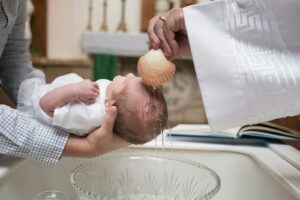
A prominent Catholic recently argued in the Irish Times for a new category of victim: those subjected to infant baptism, especially as practiced by the Catholic Church. Former president of Ireland and canon lawyer Mary McAleese declared it to be “a long-standing, systemic and overlooked severe restriction on children’s rights with regard to religion.” Really? At the very moment when thousands are being slain in Iran for protesting the brutal religious regime, McAleese apparently lies awake at night worrying about infant baptism. This is an eloquent testimony to the moral disorientation that marks our present age.
Several comments are in order. First, McAleese does not deny that baptism brings certain “spiritual” benefits, such as “expunging original sin” and “opening up … the flow of God’s grace.” But she objects to the lifelong membership of the Church that baptism claims to involve. Of course, her fear of the objective responsibilities that baptism entails only has force if she accepts that what the Church teaches about baptism is true. Yet, like a good therapeutic consumer of spirituality, she embraces what comforts her and discards what causes discomfort or demands too much.
Second, McAleese’s hyperbolic language is ridiculous. Reflecting on her own baptism, she laments that “nothing else was to shape my life so powerfully or impose such formidable restrictions on my inalienable intellectual human rights as that brief Sunday baptism ceremony 7½ decades ago.” Really? Nothing else had such a powerful impact on her life? None of her years pursuing an education? Her marriage? None of the children to whom she gave birth? None of the relationships she had with friends and mentors, intellectual and spiritual? Not one of those shaped her in a more profound way than a ceremony that she sees as deeply problematic in part because she has no recollection of it? That is very hard to believe.