
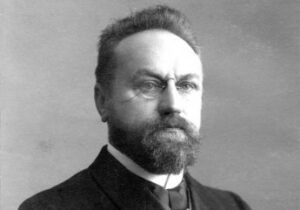
By N. Gray Sutanto, TGC. (Photo: public domain)
n How to Reach the West Again, Tim Keller called for Christians to cultivate a “Christian High Theory”: a method of contextualization whereby Christians don’t merely explain the gospel itself but also explain their own culture with the gospel. Late in his ministry, Keller turned to Herman Bavinck (1854–1921) for precisely this kind of project.
In Bavinck, we find the ground zero for many of the ways Christians in the 21st century speak about how to analyze, critique, and evangelize the late-modern world. His writings are the primary sources for concepts that have been so taken for granted that they’re used without definitions: common grace, Christianity as a worldview, and subversive fulfillment.
Oddly enough, however, Bavinck’s main works were untranslated until recently, with his four-volume Reformed Dogmatics translated in 2008 and other seminal texts like Christian Worldview and Christianity and Science as late as 2019 and 2023. Concepts like “worldview” and “common grace” have received a life of their own in Anglophone Christianity apart from the source that first articulated these notions.
In Bavinck, we find the silent influence behind many of the most formative minds in American evangelicalism and Reformed theology—figures like Keller, Francis Schaeffer, and Louis Berkhof. This is why, in Gayle Doornbos’s and my forthcoming book, The Essential Herman Bavinck, we seek to reintroduce his core texts in one volume, and why The Keller Center is including a session on Bavinck in a cohort on major figures in cultural apologetics.
Let’s consider the answers to three questions: Who was Bavinck? What were his major writings? And how does his work inform cultural apologetics for today?
Who Was Bavinck?
Bavinck was one of the first-generation Dutch neo-Calvinists who, along with his colleague Abraham Kuyper (1837–1920), sought to convey confessional Reformed orthodoxy to late-modern society and its holistic implications to every area of life.