
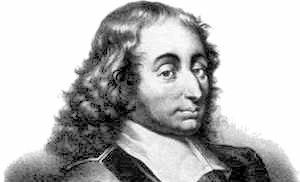
By Luke Foster, Public Discourse. (Image: Pascal – public domain)
Pascal’s theology is sublime, beautiful, and all-consuming. But it reflects the life of a celibate mystic rather than that of the statesman who must transmit Christian culture. Statesmen after all must wager.
In The Closing of the American Mind, Allan Bloom recounts hearing a Parisian waiter call his fellow waiter a “Cartesian.” “It was not pretentiousness; he was just referring to what was for him a type. … Descartes and Pascal represent a choice between reason and revelation, science and piety, the choice from which everything else follows.” Thirty-nine years after Closing was published, Pierre Manent, himself a great translator of Bloom, offers in his latest book an erudite yet charming reminder to his fellow countrymen to reread Pascal, since the key to their riddle may be found there. While correcting many scholarly misreadings, Manent never gets bogged down in footnotes, focusing frankly on the great urgency he sees in Pascal’s message not just for the French but for all the heirs of the modern West: it is not that we have successfully dismissed the call of God; it is that we have distracted ourselves, and in the process debased and subjected ourselves.
Challenging Modern Atheism and Indifference is not directly a polemic about the present; it is a series of close readings of major themes in Pascal: the Wager, his “proofs” of God’s existence, his understanding of the relationship of the Old and New Testaments, his diagnosis of self-love in relation to his predecessor Montaigne and his successor Rousseau, and perhaps thorniest of all, his treatment of the mystery of predestination. Each of these treatments is theologically profound, on Manent’s part as on Pascal’s. Manent explicates the Wager as more akin to St. Anselm’s ontological argument—designed to make us aware of the dependence of our own intellect—than to Aquinas’s reasoning from effects to causes.