
by Raymond Ibrahim
“Christ is our hope that through this little mountain, the well-being of Spain will be restored” — Pelayo, May 28, 722
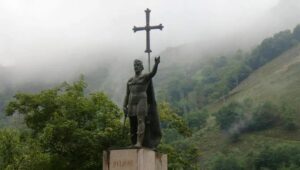
Over 1,300 years ago today, on May 28, 722, a little known but profoundly important battle was waged, setting the tone for the next eight hundred years of Christian/Muslim “coexistence” in Spain: the Battle of Covadonga.
To appreciate its significance, we must travel back eleven years earlier, to 711, when Arabs and Africans, both under the banner of Islam, “godlessly invaded Spain to destroy it,” to quote from the Chronicle of 754. Once on European soil, they “ruined beautiful cities, burning them with fire; condemned lords and powerful men to the cross; and butchered youths and infants with the sword.”
After meeting and beating Spain’s Visigothic nobles at the pivotal Battle of Guadalete — “never was there in the west a more bloody battle than this,” wrote the Muslim chronicler al-Hakam, “for the Muslims did not withdraw their scimitars from them [Christians] for three days” — the invaders continued to penetrate northward into Spain, “not passing a place without reducing it, and getting possession of its wealth, for Allah Almighty had struck with terror the hearts of the infidels.”
Such terrorism was intentionally cultivated, in keeping with the Koran (3:151, 8:12, etc.). For instance, the invaders slaughtered, cooked, and pretended to—or actually did—eat Christian captives, while releasing others who, horrified, fled and “informed the people of Andalus [Spain] that the Muslims feed on human flesh,” thereby “contributing in no small degree to increase the panic of the infidels,” wrote al-Maqqari, another Muslim chronicler.