
by Ayaan Hirsi Ali, Telegraph
Western elites insist on pretending that all cultural frameworks are moral equals. Dame Sarah Mullally should know better
In his seminal essay After Ten Years, written at the turn of 1942-1943, the German theologian and anti-Nazi resister Dietrich Bonhoeffer diagnosed a profound psychological pathology that regularly overtakes captured elites. He noted that in the face of systemic institutional pressures, individuals do not merely lose their judgment; they surrender their intellectual independence to a collective condition. In such states, Bonhoeffer warned: “The stupid person… is utterly self-satisfied and, being easily irritated, becomes dangerous by going on the attack.” Reason falls on deaf ears, and facts that contradict the prevailing group-think are simply pushed aside as inconsequential.
The modern Western establishment is currently held captive by just such a powerful institutional spell: a persistent conviction that the complex frictions of a morally and ethically splintering society can be permanently smoothed over through the mechanics of public relations, bureaucratic deference and administrative compliance. When faced with deep civilisational or theological contradictions, the modern reflex of our elite is rarely to engage in critical thinking. Instead, it is to retreat into a defensive, self-righteous insulation.
Leaders entrench themselves behind boilerplate statements and tactical retractions, hoping to survive the immediate news cycle by staying on the rehearsed message and then fleeing back to the safety of the elite bubble.
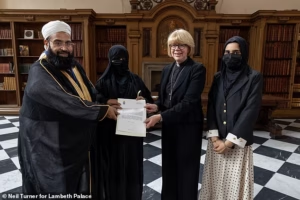
Rarely is this institutional pattern more vividly illustrated than in a single, striking photograph from Lambeth Palace that was recently released. The image caught Archbishop Sarah Mullally presenting a Lambeth Award to Hafiz Muhammad Tahir Mehmood Ashrafi, the chairman of the Pakistan Ulema Council. Standing just three feet away was Ashrafi’s wife, wrapped tightly from head to wrist, with only her eyes visible to the assembled crowd.