
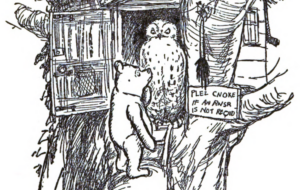
By Clement Harrold, Catholic Herald. (Image: Public Domain via Wikimedia)
Revisiting Winnie-the-Pooh as an adult reveals a work full of wit, warmth and spiritual insight, and a timely antidote to modern anxiety
In a recent appearance on Alex O’Connor’s Within Reason podcast, Philip Pullman expressed his distaste for the works of AA Milne and CS Lewis. Singling out Milne for special criticism, Pullman accused his fellow writer of peddling a maudlin nostalgia for childhood.
Spelling out his critique, the author of His Dark Materials took issue with the idea “that children are innocent… and therefore holy and, you know, they’re nearer God than we are… they’re little angels”. Pullman complains: “It’s so anti-natural, so anti the whole process of growing up. What children want to be when they’re young is grown up.”
The timing of this exchange was fortuitous for me as it coincided with my journey through Winnie-the-Pooh for the first time. I had nominated the series as part of the spring reading list for a monthly book club (an adult book club, I hasten to add). Over the past year our titles have included David Copperfield, Hannah Coulter, Bowling Alone and a 500-page work on the East India Company. But with the joy of the Easter season upon us, we decided it was time for something a little lighter.
On first reading, I found Winnie-the-Pooh to be one of the best children’s books I have ever read. The tone is delightful, the characters are whimsical and there were more than a few moments when I found myself laughing out loud. Along the way, I discovered that the river game of Poohsticks that I played as a child was invented by none other than Pooh Bear himself.
But what are we to make of Pullman’s criticisms? It is certainly true that Milne has crafted a narrative that is as appealing to adults as it is to children. That is its genius. During the podcast interview, Pullman himself admits the truth of CS Lewis’s observation that a children’s story that can only be enjoyed by children is not a good children’s story in the slightest. Much of the brilliant wit and wordplay that appears in Winnie-the-Pooh is designed for the amusement of the mother or father who reads these tales to their child.