
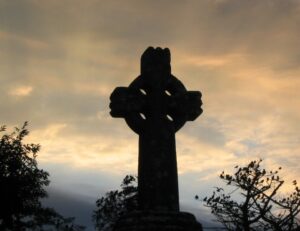
By Jeffrey B. Webb, Christian History Institute. (Image: Wiki Commons)
How early did Christianity come to Britain? If we give credence to the legend once set forth in song by William Blake (1757–1827), very early indeed:
And did those feet in ancient time,
Walk upon England’s mountains green:
And was the holy Lamb of God,
On England’s pleasant pastures seen!
Medieval legends from the twelfth century on held that Joseph of Arimathea traveled to Britain as early as AD 36 and later founded a church at Glastonbury. Others gave credit to Simon Zelotes, Aristobulus, and even Paul the Apostle for exposing early Britons to the Christian faith. Modern historians doubt these accounts and generally agree that Christianity arrived in England with the Roman Empire.
During the reign of Claudius (AD 41–54), armies under Aulus Plautius began Rome’s conquest of Britain. When he retired in 47, the empire controlled much of southeastern Britain. The Eastern Orthodox tradition maintains that Aristobulus arrived as a missionary in the wake of these conquests. He was a Jewish Cypriot who converted to Christianity and is thought to have been one of the 70 disciples mentioned in the Gospel of Luke. The Orthodox tradition describes his journey as culminating with an appointment as first bishop of Britain.
A different tradition from within Roman Catholicism cites a letter to Eleutherius (pope, c. 171–189) from Lucius, an unverified king of the Britons in the late second century, which asked the pope how he might become a Christian. As with the accounts of Joseph of Arimathea, historians have found scant evidence for these early beginnings. However, Tertullian and Origen attest to Christianity existing in Britain in writings dated from the early third century.
Regardless of how it arrived, by the turn of the fourth century, Christianity was well established in Britain. Reliable accounts of this period relate how Alban, later canonized, sheltered a Christian priest in his home north of London during the Diocletian persecutions (303–311). The priest left such an impression on Alban that he converted to Christianity. When discovered, Alban was martyred, supposedly declaring, “I worship and adore the true and living God who created all things.” A few years later, bishops from Britain attended the Council of Arles, called by Constantine to resolve issues related to the Edict of Milan.