
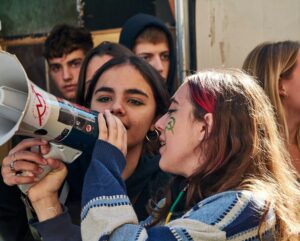
By Yaniv Regev, Public Discourse. (Image: Leonardo Basso/Unsplash)
At a moment when Americans can barely speak across political lines, we are graduating a generation that never learned how. That is not a campus problem. It is a democratic emergency.
Death to Israel!” she yelled, mid-stride, as she passed our debate table and disappeared into the crowd. I recognized her—a fellow student from my time on campus. Just minutes earlier, I had invited her to sit down with me and make her case for her position on Israel, but she declined.
This encounter happened earlier this year, when I returned to Randolph-Macon College, my alma mater in Ashland, Virginia, to host a debate on whether the West should stand with Israel. In the days leading up to the event, it gained traction: flyers spread across campus, the online poster was shared more than sixty times on social media, and on YikYak, an anonymous campus app, someone reposted it with the caption “let’s go embarrass them,” racking up nearly 100 upvotes—the top-trending post.
The passion was unmistakable. What followed was something else. Dozens showed up, but mostly to watch. One student approached the table and asked about the prompt. I invited him to debate. He hesitated, then said he “just [didn’t] have the words.” A cash prize and free donuts drew some to participate—mostly students with moderate views or none at all. The ones with the strongest convictions, several of whom I knew personally, were nowhere to be found.
This is not a story about censorship. Nobody banned the event. Nobody shut it down. The students opted out voluntarily—and that is precisely the problem.
For years, the campus free speech debate has focused almost entirely on deplatforming speakers and censoring certain kinds of speech. That fight matters. But the more corrosive problem is going largely unaddressed: a generation of true believers with no appetite for any legitimate challenge to their views.