
by Amardeep Bassey, UnHerd
Nihangs revel in swords and sovereignty
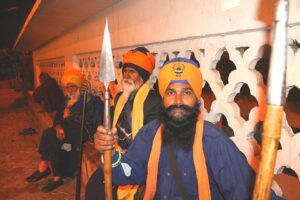
The air was thick with incense and tension. The hall was already bustling, as men and boys gathered under the shadow of ceremonial weapons and the resonant boom of a Sikh war drum. Some looked as though they were preparing for battle, wearing empty bandoliers and tactical camouflage vests, four-foot swords hanging by their sides. I was invited to sit and eat at the free kitchen, just like at every Sikh temple, as I watched the foyer fill up.
Yet as more and more people arrived, a man with a quizzical look approached me. He asked if I was a journalist. When I said I was, he told me that this was a private event, and that nobody would talk to me anyway. The meeting’s outcome, he added, would be publicised on social media. When I asked where exactly, he smiled and answered glibly. “The same channels where you found out about this meeting.” I wasn’t going to argue, shuffling past a thronged mass of conical turbans towards the door.
I had come to the Shri Guru Hargobind Sahib Ji Chauni Temple, in a quiet Coventry suburb, in search of the Nihangs: a fearsome Sikh warrior order. You likely haven’t heard of them — but you’ll almost certainly have heard of Vickrum Singh Digwa. He’s the man who stabbed Henry Nowak on a Southampton street last December, and whose resulting conviction for murder has generated one of Britain’s periodic fights about multiculturalism and belonging.
These debates have now raged for weeks, but one thing has remained largely unnoticed: a passage in Judge William Mousley’s sentencing remarks, where he paused to explain that Digwa belonged to the Nihangs, the same Sikh group I’d encountered in Coventry. This matters, and far beyond Vickrum Digwa — for the Nihangs are in many ways a symbol of our troubled moment.