
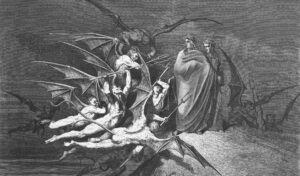
By Clement Harrold, Catholic Herald.
A recent re-reading of The Divine Comedy left me once again in awe of Dante’s genius. I turned to Penguin’s single-volume edition, guided by Robin Kirkpatrick’s translation, to weigh up all that I gained from this literary journey through hell, purgatory and heaven. Three general observations struck me and helped me discern a final reflection on what I consider to be one of the keys to unlocking the Commedia as a whole.
The first thing to notice about Dante’s masterpiece is that it is a story operating on multiple levels. It is epic quest, theological exposition, spiritual autobiography and Christian allegory all in one. Yet this last genre is the one that has stuck with me the most. If we read the Commedia as little more than a riveting safari through the afterlife then we lose sight of the work’s true literary and theological depth.
At its heart, the Commedia is a description of the threefold spiritual cycle that every Christian is called to go through. Both on a daily basis and in our lives as a whole, we must become aware of the horror of our sin (Inferno), undergo the painful process of dying to that sin (Purgatorio), and then reap the fruits that follow (Paradiso).
Secondly, the reader of the Commedia can only properly appreciate the narrative if he is willing to enter the story alongside Dante. In the opening lines of the poem, Dante makes it clear that the journey on which he is embarking is one we must all go on: “At one point midway on our path in life, I came around, and found myself now searching through a dark wood, the right way blurred and lost” (Inferno I.1–3). This is our story, and like Dante we need to have the humility to recognise when we have lost our way.