
From Anglican Futures.
Many, many words have already been written about Professor Helen King’s Private Member’s Motion that is due to be debated at the Church of England’s General Synod on July 13th. This blog offers three warnings and two suggestions as to how the threat the understanding of discipleship might be handled.
The motion is simple, but as Rev Dr Andrew Goddard, Senior Research Fellow of the Kirby Laing Institute for Christian Ethics, says,“slippery”:
“That this Synod affirm that there are no fundamental objections to being in a committed, faithful, intimate same-sex relationship, and that such a relationship can be entirely compatible with Christian discipleship.”
1) “There are no fundamental objections to…”
Dr Martin Davie, a former theological advisor to the House of Bishops, has warned that this reflects the wording of a motion passed by General Synod in 1975 – “That this Synod considers that there are no fundamental objections to the ordination of women to the priesthood.”
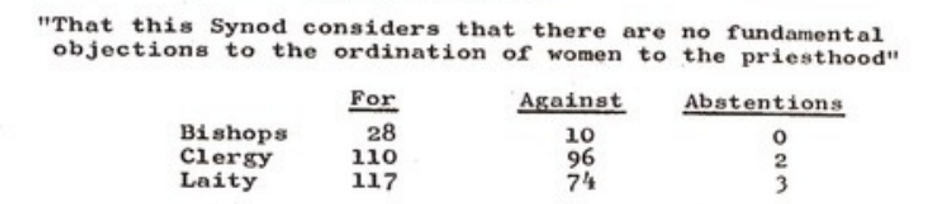
In that case, 26% of bishops, 46% of clergy and 38% of laity voted against the motion, which would suggest that a substantial minority believed there were in fact fundamental objections to the issue in question. Despite this logical fallacy, the motion guided and shaped the process over the next seventeen years – with objectors to women’s ordination being reminded again and again that the principle had already been decided.
Professor King’s motion, should it pass, will likely have a similar impact on any future debates about marriage and same-sex relationships.
2) “… being in a committed, faithful, intimate same-sex relationship”
This wording is studiously ambiguous and reflects the tangled knots in which the House of Bishops tied themselves when welcoming civil-partnerships in 2005 :
“While many partnerships will no doubt be between gay and lesbian couples who intend to be in a sexual relationship, there is likely to be a range of circumstances in which people of the same sex choose to register a partnership, including some where this is not so.”
This has been the flimsy ground on which same-sex relationships have been normalised in the Church of England, amongst both clergy and laity.
Silence on the question of the sexual element of the relationship might mean some will vote in favour of the motion. Yet, over time, if this motion passes, the linking of intimacy, faithfulness and commitment means it is likely to come to be interpreted as including sexual relationships.
3) “…that such a relationship is entirely compatible with Christian discipleship”
The doctrine of the Church of England as expressed in the introduction to the Prayers of Love and Faith is clear:
“The Church of England teaches that Holy Matrimony is a lifelong covenant between one man and one woman, blessed by God in creation and pointing to the love between Christ and the Church; a way of life which Christ makes holy. It is within marriage that sexual intimacy finds its proper place.”
This would appear to preclude the idea that couples who engage in sexual intimacy outside of the marriage union (whativer their sexuality) are living within the bounds of Christian discipleship.