
By Gavin Ashenden, Substack. (Image: Unsplash)
Souls and coins both bear the image of their creator. Reflections on Matthew 22.15-21
When Jesus was presented with a trap by two opposing parties in Jerusalem, those who cooperated with Roman rule on the one side and those who wanted to fling it off on the other, the pincer movement was designed to humiliate, embarrass and disable him in the public square.
So they brought him a coin and asked him a question, the answer to which, if he said either yes or no, was intended to be wrong and devastating for his reputation.
A small portable idol
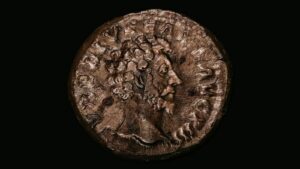
The coin, of course, was a silver denarius of Tiberius. It carried the emperor’s head on one side, and around it the claim that he was the son of God, Augustus, the former emperor. On the other side he was styled Pontifex Maximus, high priest.
A coin bearing the graven image of a man who called himself the son of God, and who at the same time claimed to be the high priest of that religion, was to a devout Jew a small portable idol. It wasn’t just a matter of using the invader’s currency. This was high-scale, high-octane idolatry.
Jesus replies, “Whose image is this, and whose inscription?” “Caesar’s,” they say. And he tells them to give back to Caesar the things that are Caesar’s.
Not a division of territory
We’ve learnt in our culture to see this as giving us a neat division of territory, as though Christ had drawn a line across human life, with money and politics on one side and prayer and spirituality on the other.
The Church has sometimes found that convenient, because it lets it off a good deal of responsibility. The modern state finds it even more convenient, because it gets to hold the faith at bay and resist its ethical questions.
But that’s not how his hearers would have heard it, or indeed how he meant it.
Eikon
Coming at this for the first time, the word that would have had the greatest impact was icon, eikon, which meant in Greek, image.
Every Jew in the courtyard had been formed by the opening of Genesis, where God makes man in his own image and after his likeness. The question about the coin turns back on those who hold it. If the coin belongs to the one whose image it bears, to whom do you belong?