
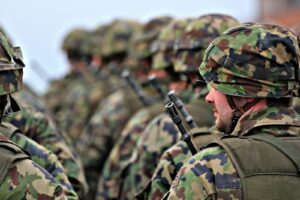
By Martin Gliniecki, Christian Today. (Image: Simon Infanger /Unsplash)
The latest YouGov polling, published in July 2026, suggests that few Britons would be willing to participate directly in the military if the UK faced an imminent threat of invasion. Just 6% of respondents said they would volunteer for military service, while a further 14% stated that they would serve only if conscripted. In contrast, 17% said they would refuse to serve, even if called up and 11% were unsure of how they would respond. The largest group, comprising 52% of respondents, believed that the armed forces would be unlikely to accept them because of their age or a disability.
Christians will be cautious of YouGov polling, following the company’s admission that data supplied for the Bible Society’s ‘Quite Revival’ report of 2025 was flawed. However, these findings closely mirror those recorded in a 2024 YouGov survey and while historic YouGov polling limits us to 2022, we can observe from the long-term source of World Values Survey (1981 to present), and recorded attitudes in World War Two and during conscription, that the latest YouGov results look less like a sudden collapse in a willingness to fight and defend the UK, and more like a drift in national patriotism over decades.
When the UK last fought against invasion in 1940, the Home Guard alone attracted around 1.5 million volunteers. Estimates place Christian identification at well over 90% of the population during World War Two, with very small numbers identifying with other religions or none. In the 2021 Census, Christianity dropped to 46% of the UK population – the first time in living memory that the majority did not identify as Christian.
Such findings raise important questions about what influences British citizens and their willingness to defend their country.