
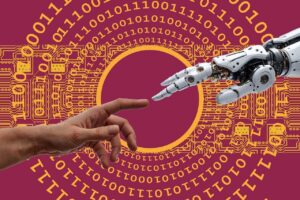
By Collin Hansen, TGC. (Image: Pixabay)
Computers were made by humans and for humans. So who decided humans now ought to become computers? Who flipped the analogy, the creator for the created?
The power behind AI is the perception of objectivity and infallibility.
Recently, we saw AI bring a Cornell mathematician to tears as he confronted the meaning of his life’s work and the capability of this new technology. As his students asked, why bother with math when AI can solve all the unsolvable problems? He was overcome with emotion and even brought the interviewer to tears as he pondered the ancient wisdom of Ecclesiastes.
What we see in this video clip is stubborn human resistance to an upside-down analogy. The rise of digital technology in the later 20th and early 21st centuries has led some enthusiasts to describe humans an inferior computers. We get tired. We get frustrated. We need food. We can’t solve math problems.
The age of humanity is giving way to the age of computers. If humans have any future, we must become more computerlike, optimized by data to live forever. Unbiased, unsentimental, we cannot afford to indulge our human frailties. Forsaking the wisdom of flawed men, we put our trust in the algorithm, which cannot tell a lie.
Exposing the Wizard Behind the Curtain
The AI Christian Benchmark 2026, released last week by The Gospel Coalition and The Keller Center for Cultural Apologetics, exposes the wizard behind the AI curtain. Yes, when tested for Bible knowledge, AI outperforms all but the most dedicated and gifted seminary students. (I remember when my family challenged me to face my sister-in-law in a Bible knowledge contest. Seminary has nothing on Awana graduates!) Just as AI can solve math problems, you can trust AI to give accurate answers when asking for objective data about the biblical text.