
by Thomas Casemore, Spectator
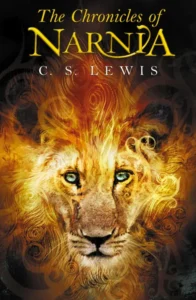
Growing up in an evangelical Christian household, it will hardly surprise you to learn that I was a big fan of C.S. Lewis’s fictional children’s series The Chronicles of Narnia. Pictured below is my own copy; one I pored over as a child, continue to deeply treasure, and look forward to reading to my own daughter in a few years’ time.
When in 2005, Andrew Adamson’s film, The Lion, the Witch and the Wardrobe, arrived in cinemas, I was amazed to see the story come to life. In subsequent years, it became one of my favourite films. As a boy, I wanted, and believed, that one day I could be brave like Peter. As I grew to understand the story as an older child, I perhaps increasingly wanted to believe that I could be redeemed like Edmund.
For a child whose parents limited what he was shown on TV, the Narnia films (three in total) were some of the few action films that I was allowed to watch, and I was inspired by them.
But I saw that the thing C.S. Lewis used to bind the world of Narnia was Aslan. He was bold, fearless, self-sacrificial. He did not flee in the face of the White Witch, but laid down his life for Edmund, a boy whose weakness for Turkish delight, and betrayal of his family, put Narnia in mortal peril in The Lion, the Witch and the Wardrobe.
There is something remarkable about the plain obviousness of Lewis’ characterisation of Aslan as Christ. Whilst Lewis did not regard Aslan as a simple allegory for Jesus, he described the Narnia stories, and Aslan, as a ‘supposal’ for Christ. In essence, an imaginative answer to the question of what Jesus might be like if He became incarnate in another world.
Whilst Lewis did not simply take Christian doctrine and paste it into a children’s fantasy world, Christianity is part of the fabric of Narnia itself. Creation, temptation, sacrifice, resurrection, moral law, providence, judgement, and the hope of new creation are all embedded within the stories.