
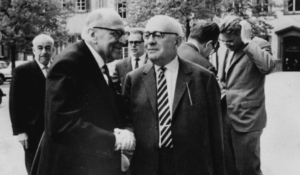
By Rick Plasterer, Juicy Ecumenism. (Photo: Wikimedia Creative Commons)
An earlier article reviewed the first part of Carl Trueman’s recent book To Change All Worlds: Critical Theory from Marx to Marcuse, which recounts the early development of Critical Theory with the Frankfurt School at the Institute for Social Research at University of Frankfurt am Main in Germany. This article will deal with critical theorists’ assessment of modernity and popular culture, the ideological basis they provided for the sexual revolution, and Trueman’s advice on responding to critical theory.
The Enlightenment Seen from the Viewpoint of Critical Theory
Trueman discussed extensively Horkheimer and Adorno’s Dialectic of Enlightenment (1947). It deals with the problems of modernity. Their style is difficult, but this, Trueman said, is because they are trying to force readers to see the underlying instability in the human world. They do identify the attempt to control nature and other people as central to understanding the dynamics of the social world. This ties the Hegelian strand of critical theory with the Nietzschean strand advanced by Foucault. What they identify is an effort at control which has changed from the use of magic in animistic society to religion, then to metaphysics, and finally to positive science. In the last stage, there is (at least the aspiration) to the “all-powerful self … a mere having, an abstract identity.” The old practical reason, which prescribed human actions by examining the ends sought in light of theology and metaphysics was dispensed with, leaving only instrumental reason, which considers the best means to achieve desired ends. A “new ideology of instrumental reason replaced the old moral codes and practices of Christianity.” How instrumental reason, which only appeals to scientific facts and technical ability can be an ideology may not seem obvious. Horkheimer, however, assures us that the instrumental reason we have is simply a product of (the oppressive) society. Such statements as “the experts say” make clear that an authority that the public is asked to take on faith is being appealed to. Horkheimer proposed a dialectical move from bondage to God, to freedom (which comes with secularization), to bondage to instrumental reason (as defined by the “experts”).